

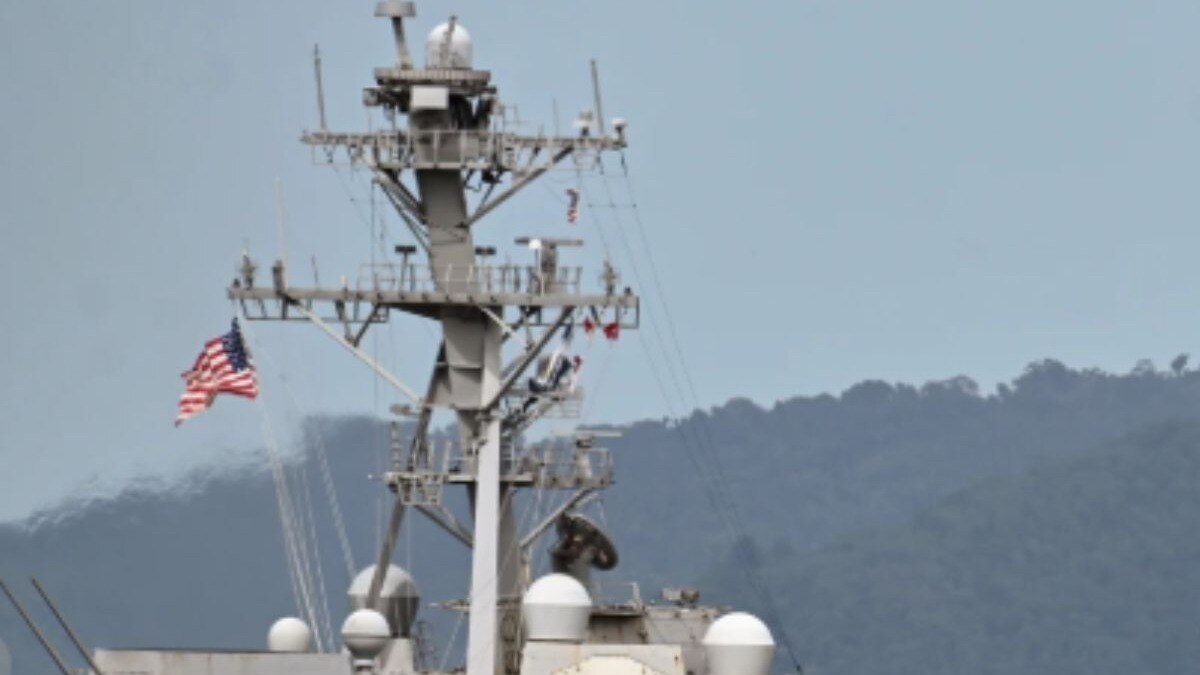

Venezuela has accused Trinidad and Tobago, in collaboration with the US Central Intelligence Agency (CIA), of orchestrating a ‘military provocation’ to incite a significant confrontation with Caracas. This accusation coincided with the arrival of a US warship in Trinidad and Tobago’s capital, Port of Spain, as a demonstration of Washington’s military presence in the region.
Vice President Delcy Rodrguez disclosed that Venezuelan security forces had apprehended a group of mercenaries allegedly in possession of “direct information from the American intelligence agency.” Their mission was purportedly to carry out a “false flag” attack in the Caribbean region.
In an official statement, Rodrguez warned of an ongoing false flag operation in the waters near Trinidad and Tobago or from territories of either country to provoke a military conflict with Venezuela. However, no concrete evidence or additional details were provided to support this claim.
The Venezuelan government criticized the joint military exercises between the US and Trinidad and Tobago as a significant threat to the Caribbean region and deemed it a hostile act against Venezuela.
The USS Gravely, a guided missile destroyer, recently docked in Port of Spain for joint training operations with Trinidad and Tobago’s armed forces. This deployment follows the positioning of the USS Gerald R. Ford aircraft carrier group closer to Venezuelan waters as part of an expanded US naval presence in the Caribbean.
Officials from both the US and Trinidad and Tobago asserted that the exercises aim to address mutual security challenges, such as transnational crime, through training, humanitarian missions, and security operations.
While a senior military official in Trinidad and Tobago mentioned that the US warship visit was a recent arrangement, Prime Minister Kamla Persad-Bissessar expressed support for the US military activities targeting drug trafficking near Venezuela’s coast.
However, the presence of the warship also sparked criticism domestically. At a protest outside the US Embassy in Port of Spain, David Abdulah, the leader of the Movement for Social Justice party, condemned the move as unacceptable, emphasizing the proximity of the warship to Venezuela amid heightened tensions.
Caricom, the regional bloc encompassing Trinidad and Tobago, has advocated for dialogue to prevent further escalation in the region.
Conversely, Venezuelan President Nicols Maduro denounced the US naval build-up as part of a strategy by the Trump administration to instigate a prolonged conflict against Venezuela. President Trump recently authorized covert operations in Venezuela by the CIA and accused Maduro of leading the criminal organization Tren de Aragua without providing evidence.
The US has conducted multiple operations targeting drug-trafficking boats in the Caribbean and Pacific, citing these actions as part of a broader campaign to combat organized crime in the region.
Maduro has previously accused the US of planning “false flag” incidents, including an alleged scheme to plant explosives at the US embassy in Caracas. The US State Department and CIA have refrained from commenting on the recent allegations from Caracas.