

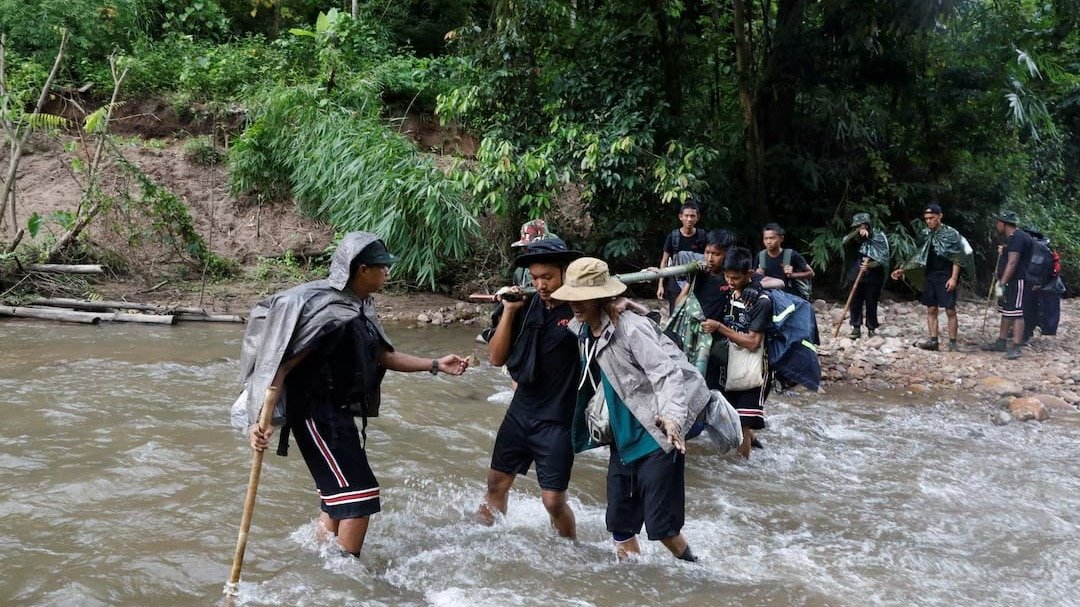

A recent operation by the Burmese military regime targeted a Chinese mafia-controlled compound in KK Park, Myanmar, prompting approximately 700 trafficked foreign workers, including numerous Indians, to flee. Many of them sought refuge in Thailand by swimming across the Moei River, according to the Thai army.
While some individuals perished due to the river’s swift currents, others opted to escape to different parts of Myanmar’s Myawaddy region rather than risk deportation by crossing into Thailand, as per the Thai Public Broadcasting Service.
The crackdown took place in the infamous Myawaddy region, which has earned the moniker of the “global capital of scams.” The Thai army confirmed that 677 people, comprising 618 men and 59 women, entered Thailand’s northern Tak province and were apprehended.
The Irrawaddy, a Burmese news outlet, mentioned that a large number of workers fled the compound amid rumors of impending military raids. Although the junta claimed to have confiscated 30 Starlink satellite receivers and other communication devices, they asserted there was no evidence of criminal activities.
In contrast, SpaceX, owned by Elon Musk, terminated services to over 2,500 Starlink internet devices at scam centers in Myanmar. A company executive revealed that the usage of Starlink internet had surged within the illicit industry across Southeast Asia.
Critics labeled the raid as a staged publicity stunt orchestrated by the junta’s ally, the Karen Border Guard Force (BGF), which oversees KK Park. Observers suggested that the raids were orchestrated to portray a crackdown on cybercrime.
According to reports, the junta uncovered more than 200 buildings and approximately 2,200 workers at the site, including 98 security personnel. However, a source within KK Park asserted that scam operations continued unabated, with no arrests made.
Thai authorities allowed individuals primarily from Argentina, Malaysia, China, Vietnam, Thailand, and South Korea to cross the border. Nonetheless, thousands remained stranded at the border, awaiting permission to proceed. Eight Indian nationals who had lost their way were rescued and provided temporary shelter before their legal entry into Thailand.
Refugee support organizations in Myanmar are gearing up to provide food assistance to around 2,000 workers fleeing KK Park. Meanwhile, Thai authorities are making arrangements for reception areas on their side of the border.
KK Park, a cybercrime hub in Myanmar managed by Chinese criminal syndicates and guarded by local militias loyal to Myanmar’s junta, has been identified by Justice for Myanmar (JFM) as a center for transnational organized crime. The illicit activities in KK Park fund various abuses and international crimes, including land control, real estate scams, extortion, human trafficking, and smuggling.
The border region encompassing Myanmar, Vietnam, and Laos, characterized by challenging terrain and weak governance, has become a breeding ground for cybercrime networks. Despite rescue efforts, the scale of these operations remains vast, posing significant challenges to dismantling these criminal networks.
The recent crackdown at KK Park sheds light on the lawlessness in Myanmar, underscoring the prevalence of Chinese mafia-run scam centers and the plight of trafficked Indians coerced into engaging in cybercrime activities.
This development highlights the ongoing challenges in combating cybercrime in the region and the need for international collaboration to address these criminal enterprises effectively.