

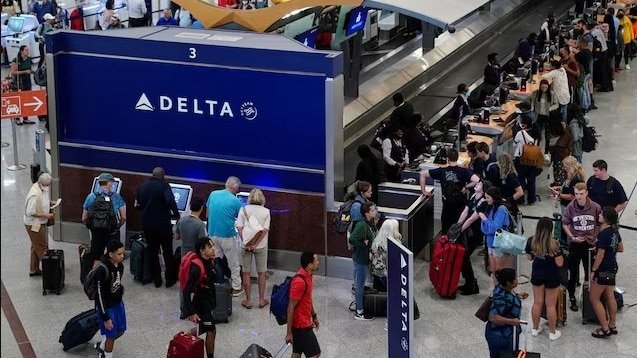

US air travel faced increasing disruption on Monday as over 5,600 flights experienced delays across the country. The ongoing federal government shutdown, now in its 27th day, led to a surge in air traffic controller absences, causing significant operational challenges.
The Federal Aviation Administration attributed the delays to staffing shortages, resulting in ground delay programs being implemented at Newark Airport, Austin Airport, and Dallas Fort Worth International Airport. Earlier, flights in the southeast were impacted due to severe staffing shortages at the Atlanta Terminal Radar Approach Control.
Approximately 13,000 air traffic controllers and 50,000 Transportation Security Administration officers are working without pay following a budget impasse between President Donald Trump and congressional Democrats that triggered the shutdown. The Trump administration cautioned that flight disruptions would worsen as controllers missed their first full paycheck on Tuesday.
On Sunday, more than 8,800 flights were delayed, with Southwest Airlines experiencing 47% of its flights delayed, followed by American Airlines at 36%, United Airlines at 27%, and Delta Air Lines at 21%, according to FlightAware. By Monday evening, Southwest had 31% of flights delayed, American 24%, Delta 18%, and United Airlines 12%.
A US Department of Transportation official reported that 44% of Sunday’s delays were due to controller absences, a sharp increase from the typical 5%. The growing delays and cancellations are causing public frustration and drawing attention to the shutdown’s impact, increasing pressure on lawmakers to find a resolution.
Transportation Secretary Sean Duffy engaged with controllers in Cleveland on Monday, while the National Air Traffic Controllers Association union planned events at various airports on Tuesday to highlight the missed paychecks. The FAA, already facing a shortage of about 3,500 air traffic controllers, had many working overtime and six-day weeks even before the shutdown.
During a 35-day shutdown in 2019, controller and TSA officer absences rose as workers missed paychecks, leading to extended wait times at airport checkpoints and air traffic restrictions in major cities like New York and Washington.