

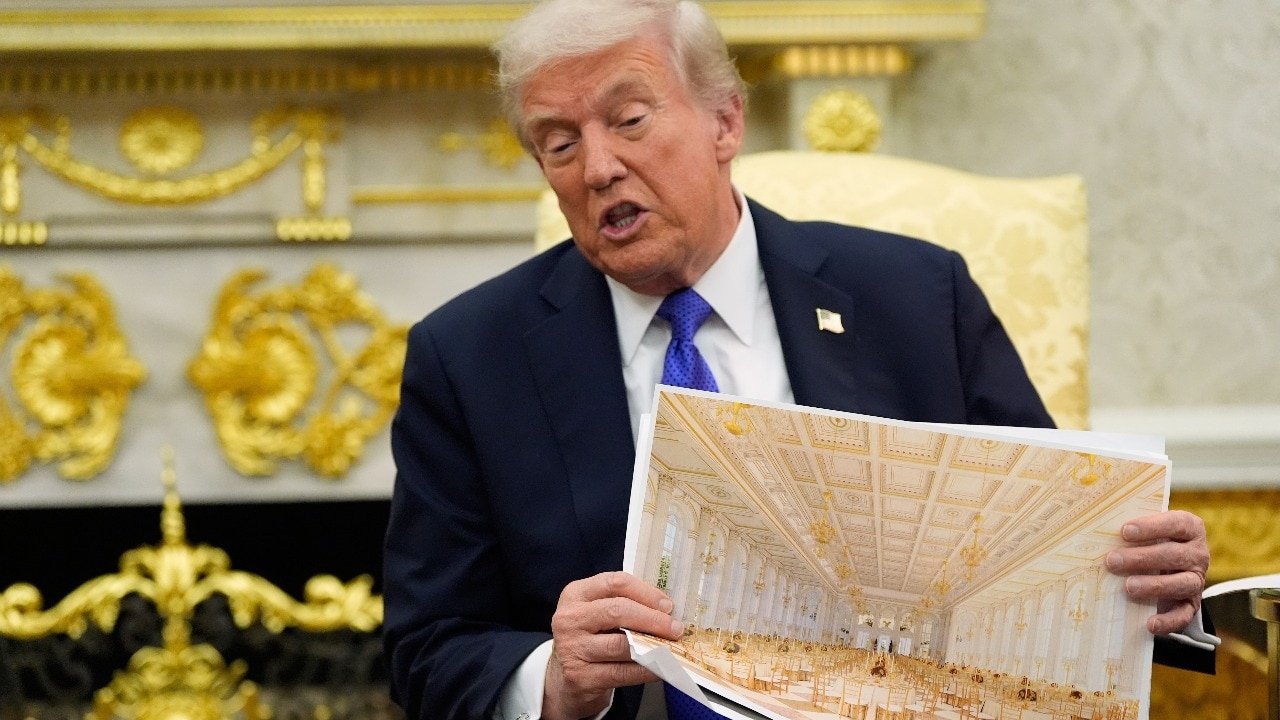

US President Donald Trump is changing the White House into a gold-leaf adorned replica of his Mar-a-Lago estate. The latest phase of this endeavor involves creating a gold-tinted ballroom within the White House premises. To accomplish this, Trump has initiated the demolition of the entire East Wing of the White House. The approach taken by Trump, marked by the use of bulldozers, lack of approvals, and exceeding costs, draws parallels to common infrastructure projects in India.
Recently, bulldozers were seen at the White House, dismantling bricks that were laid more than 80 years ago during Franklin D Roosevelt’s presidency. This demolition paves the way for Trump’s personal initiative to construct a golden-themed ballroom, replacing the historic East Wing. This wing, known for housing the office of the First Lady of the United States (FLOTUS) and her staff since its construction in 1942, has been a significant space for 14 First Ladies, including notable figures like Michelle Obama, Hillary Clinton, Barbara Bush, and Melania Trump.
The decision to proceed with the project without seeking approval from the National Capital Planning Commission, the usual authority for endorsing major federal construction projects in DC, has raised concerns. The construction appears to have been unilaterally sanctioned by Trump, bypassing the usual channels of approval. This move has drawn comparisons to construction practices in India, where adherence to official protocols is sometimes overlooked, as seen in a recent incident in Nagpur involving a flyover cutting through a personal balcony.
The construction of the ballroom at the White House mirrors ceremonial practices common in India, where foundation stones are laid amid grand ceremonies and official approvals are sometimes bypassed. The unveiling of the ballroom project, which was initially undisclosed to Congress until an official statement was released by the White House, raises questions about transparency and procedural adherence.
Remarkably, the proposed 90,000 square foot ballroom, intended to accommodate up to 999 people for various functions, including political fundraisers, surpasses the size of the White House itself by a significant margin. The project’s escalating costs, starting at $100 million and later doubling to $200 million, rising further to $300 million within a year, align with a trend familiar in Indian infrastructure projects where initial estimates often escalate substantially as work progresses.
The White House’s decision to forge ahead with the construction without formal approval from the National Capital Planning Commission reflects a similar flexibility in approach observed in Indian construction practices. The commission’s chairperson, who is closely associated with Trump, downplayed the lack of jurisdiction over demolition activities on federal properties. This parallels Trump’s history of initiating major projects without full Congressional consent, such as the controversial US-Mexico border wall.
In a move reminiscent of legacy-building projects undertaken by politicians worldwide, Trump’s grand ballroom initiative at the White House symbolizes his desire to leave a lasting impact. By constructing a lavish ballroom larger than the White House itself and adorned in his preferred golden hue, Trump aims to etch his legacy into American history. The project’s progression, from demolition to cost escalations, echoes the narrative of an Indian construction endeavor. The unfolding developments at the White House may draw mixed reactions, but for some observers in India, it serves as a familiar tale of construction practices.