

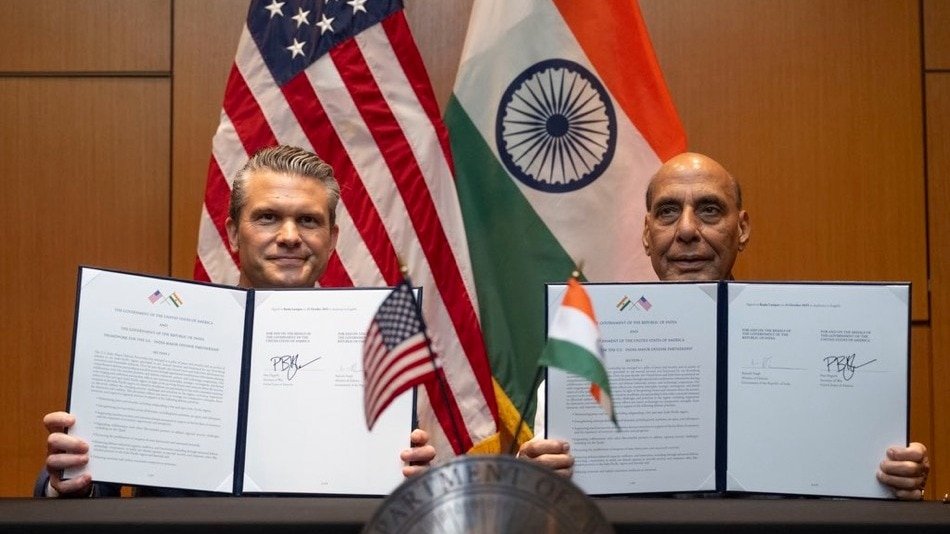

In a complex scenario, India and the US are entangled in a trade dispute while unveiling a defense agreement aimed at enhancing regional stability. The pact, praised by Defense Secretary Pete Hegseth as pivotal, and by India’s Rajnath Singh as a new era of collaboration, raises concerns about the imbalance in trade dynamics. Despite the rhetoric of cooperation, the agreement primarily benefits the US in selling arms to India.
The contradiction is stark as the US promotes domestic production through its “Make in America” policy, raising questions about where the envisioned co-production will take place. While Washington pledges joint manufacturing, it restricts technology transfers and imposes bureaucratic hurdles, limiting India’s role to assembly rights rather than true innovation. This setup results in profits flowing predominantly back to the US.
President Trump’s recent diplomatic engagements further highlight the asymmetry. His favorable meetings with Xi Jinping and tariff reductions on Chinese goods, coupled with increased engagement with Pakistan, contrast with India receiving primarily defense equipment. India’s strategic stance on keeping commerce and defense separate to protect key sectors may have inadvertently favored the US, leading to a partnership that lacks economic balance.
The long-term defense framework offers strategic benefits by enhancing military coordination and intelligence sharing in the Indo-Pacific region. While this solidifies operational ties between India and the US, the underlying motive appears more geared towards securing revenue for American defense contractors rather than fostering genuine co-production opportunities in India.
Beyond the diplomatic facade, the agreement seems to serve as a prolonged procurement arrangement for major US defense companies, raising concerns about the nature of the partnership. It prompts a critical question of whether India is viewed as an equal partner or merely a customer by the US. The current dynamics suggest a tilt towards the latter, posing challenges to the perceived balance in the relationship.
The significance of this deal lies not just in its strategic implications but also in defining the nature of the Indo-US partnership. As India navigates this alliance, the focus shifts towards ensuring equitable cooperation that goes beyond arms sales. The evolving dynamics between the two nations will determine whether the pact truly reflects a mutually beneficial collaboration or reinforces a one-sided transactional relationship.