

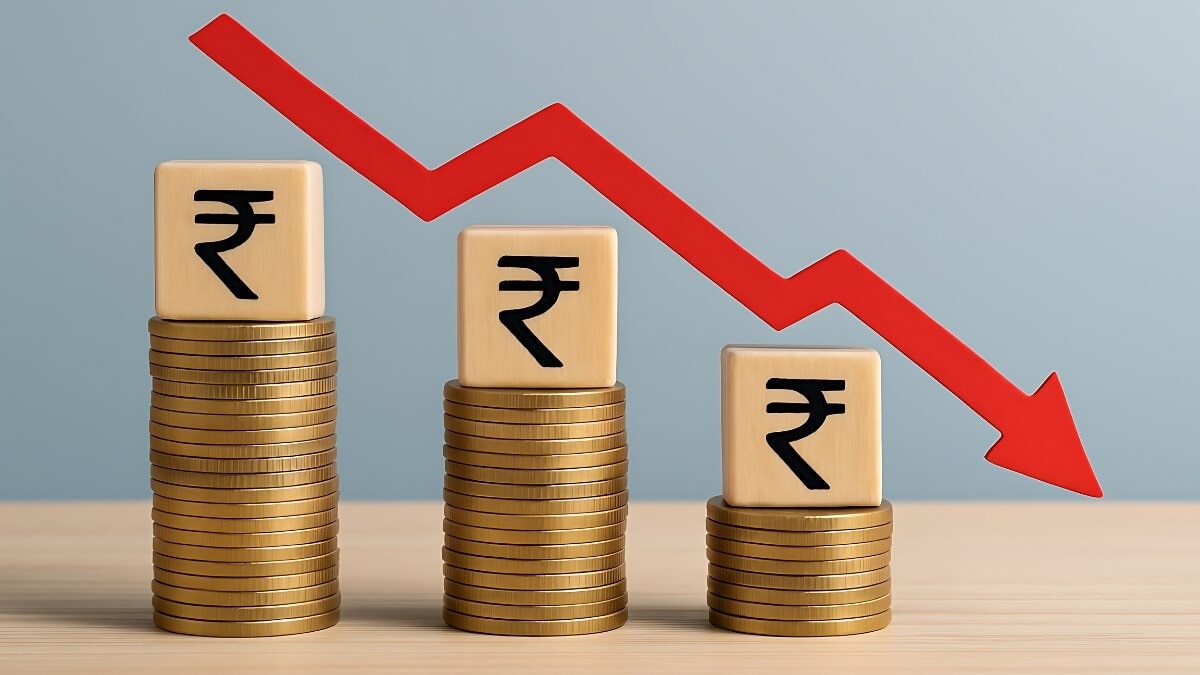

On Tuesday, the rupee reached an unprecedented low as a result of poor global sentiment, capital outflows from foreign investors, and uncertainty regarding a trade agreement with the US. Despite some encouraging trade statistics, the rupee faced ongoing challenges against a robust US dollar.
During trading, the currency dropped to 91.075 per dollar before closing approximately 0.3% down at 91.0275, according to Reuters. This year, the rupee has depreciated by over 6% against the dollar, positioning it as one of the weakest emerging market currencies in 2025.
FOURTH STRAIGHT SESSION OF RECORD LOWS
This marked the fourth consecutive trading session that the rupee hit an all-time low. Traders indicated that demand for hedging and portfolio withdrawals are contributing to the downward pressure, while investors remain wary due to the lack of clarity surrounding US-India trade discussions.
Market observers suggest that a significant recovery in the rupee is improbable unless there is a definitive breakthrough in negotiations with Washington.
TRADE DATA BETTER, BUT PRESSURE PERSISTS
The trade figures for November provided a glimmer of hope, with India’s exports increasing significantly despite high US tariffs, thereby bolstering India’s stance in trade talks and reducing the urgency to finalize a deal.
However, this improvement has yet to offer support for the rupee.
“A further sharp decline in the rupee was not anticipated today given that November’s trade data exceeded expectations,” remarked Dr VK Vijayakumar, Chief Investment Strategist at Geojit Investments Limited.
He also mentioned that short covering might have influenced the movement of the day. “Ongoing selling by foreign institutional investors is creating a detrimental cycle, driving the rupee down,” Vijayakumar stated.
RBI STAYING ON THE SIDELINES
Typically, significant declines in the rupee prompt the Reserve Bank of India (RBI) to intervene by selling dollars to stabilize the currency. However, this time, the central bank seems content to allow the currency to find its own level.
“Lately, the RBI’s approach has been to permit the currency to depreciate,” Vijayakumar elaborated. “The low inflation rate in India is a factor in this decision to refrain from intervention.”
With India’s inflation at merely 0.71% in November, the RBI has the flexibility to hold back. Vijayakumar also pointed out that the current rate of rupee depreciation is not adversely affecting the economy.
FII SELLING AND WEAK GLOBAL MOOD
So far in 2025, foreign investors have divested over $18 billion in Indian stocks. The prevailing global risk-averse sentiment also impacted domestic markets on Tuesday, resulting in a roughly 0.6% drop in the benchmark Nifty 50.
However, Vijayakumar highlighted a positive development. “The reduction in India’s November trade deficit to $24.53 billion from $41.68 billion in October is favorable for the rupee,” he noted.
For the time being, investors remain cautious, closely monitoring US economic indicators, global risk sentiment, and capital flows to predict the future trajectory of the rupee.