



The concept of a four-day work week has resurfaced in India, gaining renewed interest following a recent announcement from the Ministry of Labour and Employment.
Workers across the nation are pondering a crucial question: is it feasible for Indians to work just four days a week while still receiving compensation for a full week’s worth of work? The concise answer is potentially yes, but it hinges on the explicit guidelines outlined in the newly introduced Labour Codes.
<pIn a message shared on X (previously known as Twitter), the Ministry indicated that the new Labour Codes permit flexibility in the arrangement of weekly working hours.
This indicates that a four-day work week is achievable, but it does not imply a reduction in total working hours. The weekly working hours are set at 48, and the regulations surrounding pay and overtime remain intact.
WHAT DID THE LABOUR MINISTRY SAY
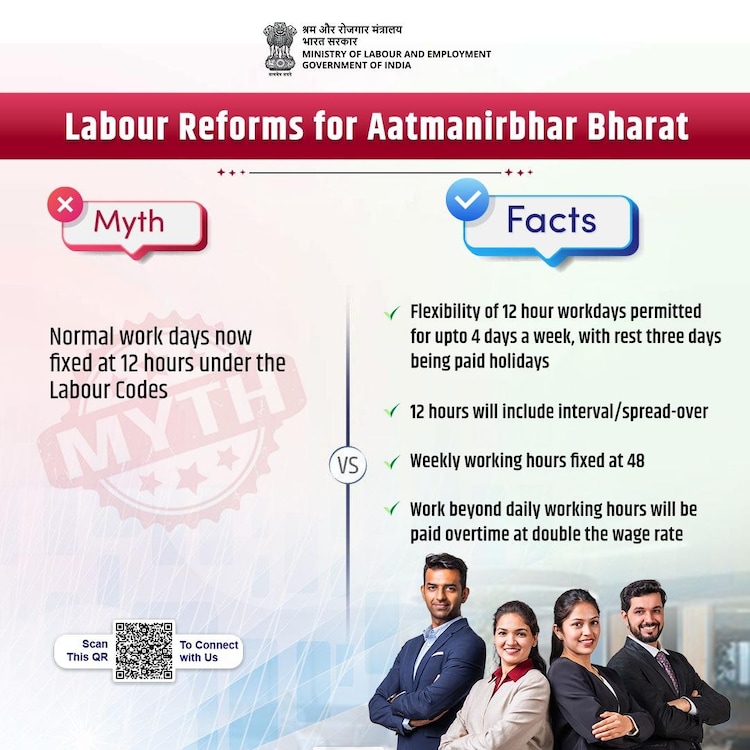
The Ministry of Labour and Employment stated, “The Labour Codes provide flexibility for 12 hours over four workdays, with the remaining three days designated as paid holidays. The total weekly working hours remain capped at 48, and any overtime performed beyond the daily limit must be compensated at double the regular wage.”
Consequently, an employee can work up to 12 hours a day for four days while enjoying three paid days off. However, the total hours worked in a week cannot exceed 48. Should an employee exceed 12 hours in a day, the additional hours will be categorized as overtime and compensated accordingly at double the standard wage.
The 12-hour workday referenced by the Ministry does not necessitate continuous work for the entire duration. The Ministry clarified that this timeframe includes breaks and can feature staggered working hours. This may encompass lunch breaks, rest periods, or intervals between shifts, contingent on the job’s nature.
Despite this flexibility, employers are prohibited from requiring employees to exceed 48 hours of work per week. This regulation aims to offer both employers and employees greater choice in organizing work schedules while safeguarding workers from excessive and unpaid labor.
4-DAY WORKING WEEK ON CARDS?
The Labour Codes do not mandate a four-day work week; it remains an option for mutual agreement between companies and employees. Some workplaces may opt to maintain a five or six-day work week, while others might transition to four longer days.
The ultimate choice will rely on company policies, regional regulations, and the specific nature of the work. Not all positions can seamlessly adapt to a 12-hour workday structure, particularly in industries that require continuous staffing.
What are the new Labour Codes?
On November 21, 2025, the government replaced 29 previous labour laws with four new Labour Codes. These include:
Code on Wages, 2019
Industrial Relations Code, 2020
Social Security Code, 2020
Occupational Safety, Health and Working Conditions Code, 2020
The objective of these codes is to simplify and standardize labour laws throughout the nation. They emphasize timely wage payments, defined working hours, worker safety, health services, and social security provisions.
Puneet Gupta, Managing Director at Protiviti Member Firm for India, noted that the new Labour Codes provide clarity and facilitate compliance for organizations.
He mentioned that consolidating 29 laws into four codes diminishes confusion and aids companies in managing their workforce more effectively. According to him, this new structure enhances uniformity across states and allows firms to navigate compliance with greater ease.
He also highlighted that expanding social security is a significant advancement. For the first time, gig and platform workers are officially acknowledged under labour laws, making the system more inclusive.
A notable alteration under the new Labour Codes concerns fixed-term employees. These workers are now entitled to the same benefits as their permanent counterparts, including leave, health coverage, and social security benefits.
Previously, fixed-term employees often received different treatment. Now, they must receive wages comparable to permanent staff performing similar roles.
Additionally, changes have been made regarding gratuity regulations. Fixed-term employees can now qualify for gratuity after just one year of continuous service, down from the previous requirement of five years.
For the first time, gig workers, platform workers, and aggregator workers are formally recognized under labour laws. This includes individuals engaged in app-based services and digital platforms.
Contributions to welfare funds for these workers will be portable through Aadhaar-linked Universal Account Numbers, ensuring that workers can retain their benefits even when switching platforms or jobs.
While the regulations permit a four-day work week, it does not serve as a universal remedy. Some industries may adopt it more readily, while others may choose to stick with existing schedules.
Currently, the Labour Ministry’s clarification emphasizes that India is not reducing work hours but is instead facilitating more flexible arrangements for accomplishing them. Whether this leads to a broader transition to a four-day work week will hinge on how companies and employees choose to utilize this flexibility in the years ahead.