

Microsoft appears to be gearing up for one of the most ambitious transitions in internal coding that the software sector has experienced in years. A senior engineer from the company has publicly shared a long-term vision aimed at phasing out all C and C++ code from Microsoft’s products by the decade’s end. This concept, which was communicated via a job-related LinkedIn announcement, envisions a future where extensive, intricate codebases are rewritten at an extraordinary speed, utilizing a blend of artificial intelligence and algorithm-driven methodologies. While this assertion may sound radical at first, the specifics indicate that Microsoft is already establishing the foundation to make this vision a reality.
Microsoft aims to replace all C and C++ code with Rust, says an engineer who must produce 1 million lines monthly
This initiative was disclosed by Galen Hunt, a senior engineer at Microsoft with nearly 28 years of tenure at the firm. He also mentioned an opening for a Principal Software Engineer (IC5) located in Redmond. In his announcement, Hunt explicitly stated his ambition to eradicate all C and C++ code within Microsoft by 2030. The preferred replacement language is Rust, which has consistently gained traction for systems-level programming due to its emphasis on memory safety and performance without the need for garbage collection.
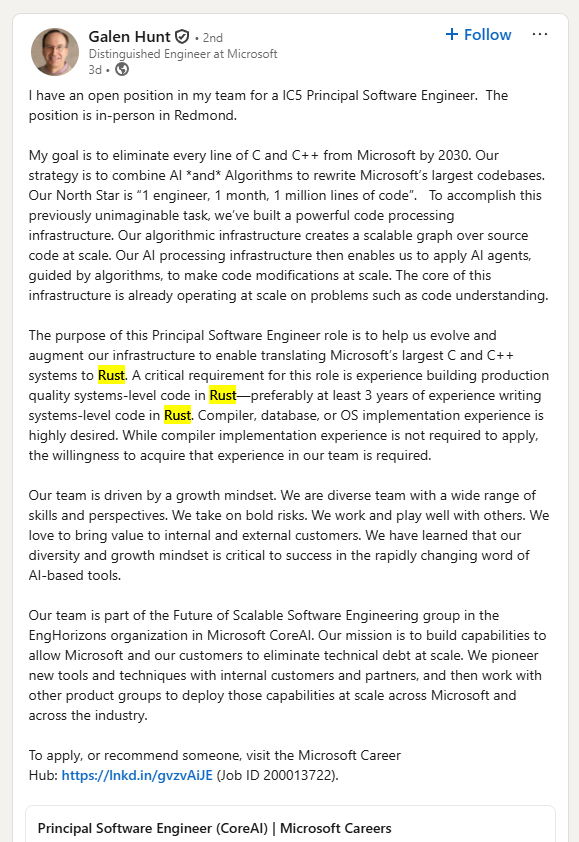
One of the most striking elements in Hunt’s announcement is what he refers to as the team’s “North Star” metric: one engineer, one month, one million lines of code. This benchmark indicates the scale at which Microsoft intends to function. Typically, rewriting even a few thousand lines of legacy system code is regarded as risky and labor-intensive. Microsoft’s strategy seeks to overturn that notion by employing AI agents guided by algorithmic systems to modify and translate code on a grand scale.
As per Hunt, Microsoft has already developed a robust code-processing framework to facilitate this initiative. At the algorithm level, the system constructs a scalable graph over the source code, enabling it to comprehend relationships and dependencies within extensive codebases. Layered above this is an AI processing component that utilizes AI agents to implement code changes, with algorithms directing those modifications to ensure accuracy and structure. Hunt mentioned that the foundation of this infrastructure is already operational at scale, particularly concerning tasks related to code comprehension, which is a crucial initial step before any large-scale translation can occur.
The newly introduced Principal Software Engineer position is designed to advance this infrastructure further, specifically aimed at enabling the transformation of Microsoft’s largest C and C++ systems into Rust. The job description clearly indicates that this is not a theoretical or experimental position. Candidates should possess strong, practical experience in writing production-quality, systems-level Rust code, ideally for a minimum of three years. Experience in fields such as compilers, databases, or operating systems is considered highly desirable, emphasizing the low-level and performance-critical nature of the work involved.
While prior compiler experience is not a requirement at the time of application, Hunt stressed that anyone joining the team must be prepared to develop that expertise. This stipulation suggests that the translation process will extend beyond mere syntax conversion and will likely necessitate significant changes in how systems function, are optimized, and are validated during runtime.
Hunt also shared insights into the team culture surrounding this project. He described the group as one that embraces a growth mindset, unafraid to take significant risks, and built on diverse skills and viewpoints. According to him, this mentality is vital in a time when AI-driven tools are swiftly transforming how software is crafted and maintained. The team’s overarching mission is to assist Microsoft, and eventually its clients, in eliminating technical debt on a large scale rather than addressing it piece by piece.
Organizationally, the team operates within the Future of Scalable Software Engineering group under Microsoft’s EngHorizons organization, which is a segment of Microsoft CoreAI. Its objectives extend beyond internal tools. The group aspires to innovate new techniques with internal teams first and then collaborate with other product groups to widely implement those capabilities throughout Microsoft and potentially across the broader software industry.
Although Microsoft has not officially declared a company-wide initiative to eliminate C and C++, Hunt’s post provides a rare insight into the seriousness with which the company is contemplating large-scale code modernization.