

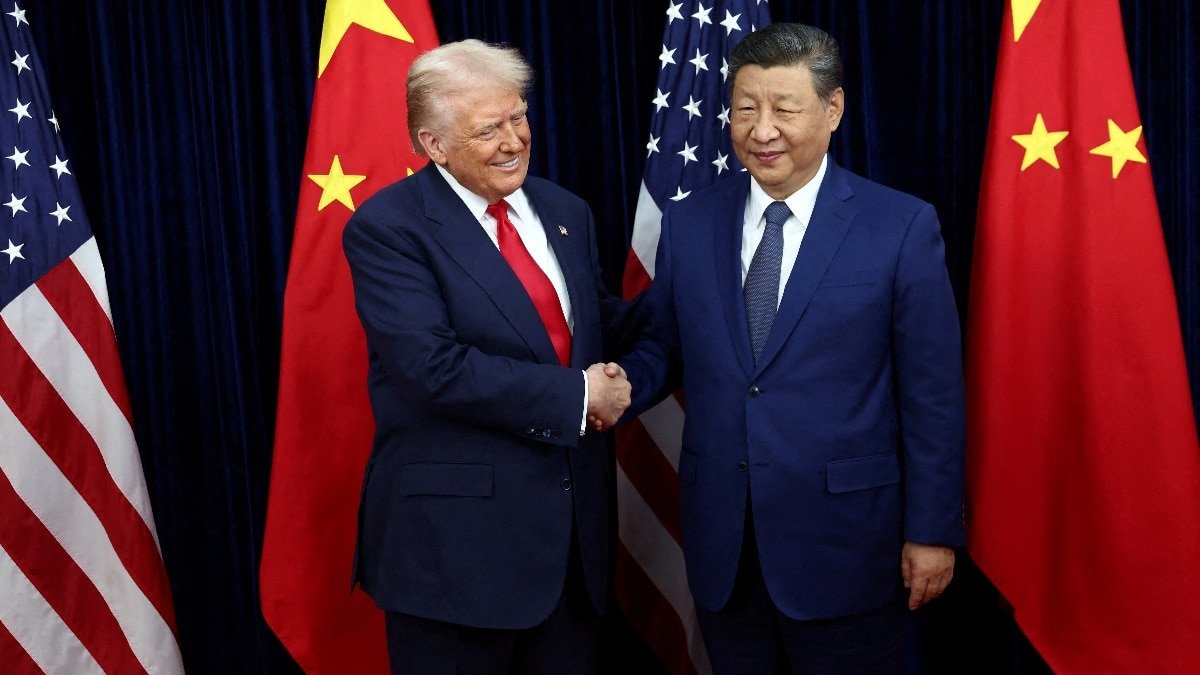

Donald Trump referenced the ‘Group of 2’ (G2) ahead of his meeting with China’s President Xi Jinping in South Korea on October 30.
The G2 concept represents a potential collaboration between the two leading global economic forces to jointly manage international affairs.
Observers are keen to understand if Trump’s mention of G2 signals a shift in US policy towards establishing a direct Washington-Beijing axis for major deals, potentially sidelining broader multilateral engagements.
The meeting between Trump and Xi in Busan focused on easing the ongoing US-China trade tensions and lasted less than two hours. No official statement was issued by the US following the meeting.
Remarks from Trump to US journalists post-meeting did not suggest a division of global influence akin to a G2 scenario post-World War II.
Trump highlighted progress in various areas, including China agreeing to buy US soybeans, supply rare earth minerals to the US, and combat illicit fentanyl trade. In return, the US reduced tariffs on Chinese goods by 10-47%.
The Chinese statement released independently post-meeting had a tone reminiscent of G2 ideals, emphasizing joint responsibility of major powers in addressing global challenges for mutual benefit.
This statement echoed the optimistic sentiment of US policymakers who envisioned the G2 concept. On the 30th anniversary of US-China diplomatic relations, former US National Security Adviser Zbigniew Brzezinski described the G2 as a significant opportunity for both nations to shape the future.
Henry Kissinger, a key figure in US-China relations, advocated for co-evolution over competition, stressing the need for global cooperation on critical issues.
While the idea of a US-China partnership has been discussed, both countries have rejected a formal G2 framework historically. China prefers multilateral approaches through entities like the UN and BRICS to avoid being viewed as subordinate to the US.
The US also values multilateralism, with Trump emphasizing American leadership. The concept of a G2 raises concerns among regional allies like Japan, South Korea, and Taiwan, as well as the potential impact on organizations such as NATO and AUKUS.
Trump’s social media reference to G2 seems more rhetorical than indicative of a concrete shift in US strategy. It should be interpreted as tactical language rather than a strategic endorsement of G2 collaboration.