

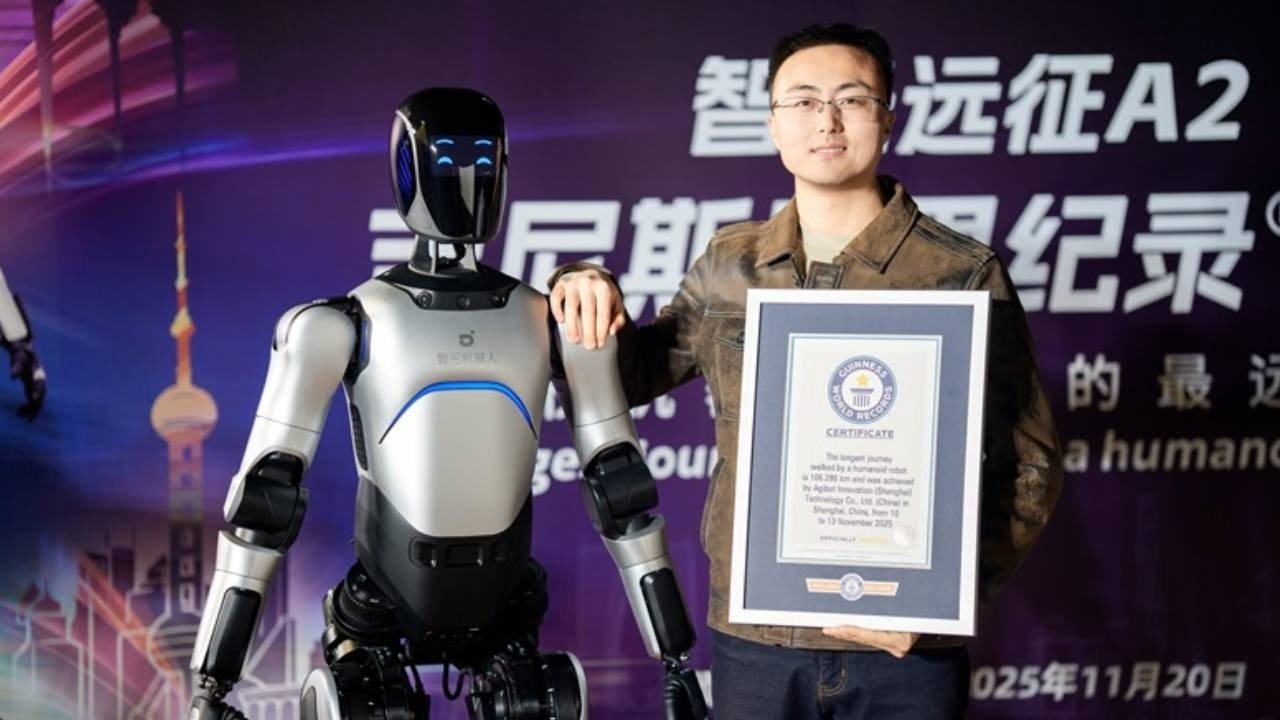

An extraordinary achievement has been unlocked by a Chinese humanoid robot, surpassing even marathon runners. Known as Agibot A2, the robot successfully covered an astounding distance of 106.286 kilometers without any human intervention, securing a Guinness World Record for the longest journey undertaken by a humanoid robot.
During the period from November 10 to November 13, Agibot A2 embarked on a challenging expedition from Suzhou to Shanghai, navigating through highways, urban streets, and bustling public areas before reaching the picturesque Bund waterfront in Shanghai. The nearly three-day journey not only tested the robot’s physical endurance but also its capability to autonomously maneuver through real-world settings.
The Unstoppable Walking Robot
According to the Guinness World Records website, Agibot A2 underwent extensive fine-tuning in preparation for this remarkable feat. The site mentioned, “The AgiBot A2 robot was optimized between April and May 2025 to ensure stability during prolonged operational periods.”
The robot’s prior achievement on August 17 included a 24-hour autonomous walk in extreme temperatures of nearly 40°C, which was live-streamed online, but the recent 100-kilometer journey was hailed by Guinness as a “significant breakthrough” for Agibot A2.
Standing at a height of 1.75 meters (5.74 feet) and weighing approximately 55 kilograms, Agibot A2 is equipped with AI-driven sensors enabling it to process textual, auditory, and visual data. Throughout the record-setting trek, it relied on dual GPS modules, lidar technology, and infrared depth cameras to handle various challenges, from changing light conditions to unexpected urban obstacles.
Interestingly, the Agibot A2 used in the event was a commercially available model, identical to those already in use by clients, indicating no special modifications were necessary to accomplish this remarkable milestone.
Agibot A2
Upon completing the journey, the humanoid robot showcased a hint of personality, describing the trek to journalists as a “memorable experience” in its “machine life” and humorously mentioning the potential need for “a new pair of shoes.”
The developer of the robot emphasized that this achievement signifies progress in balance control, hardware durability, and energy efficiency, crucial for future commercial applications. The company stated to the Global Times, “Walking from Suzhou to Shanghai is a challenging task for many individuals to accomplish in one go, yet the robot successfully achieved it.”
Besides walking capabilities, Agibot A2 can engage in multilingual conversations, perform facial recognition, retain memories of past interactions, and manage autonomous guiding and delivery responsibilities. These functionalities align with the company’s vision of humanoid robots contributing to education, hospitality, logistics, and other sectors.
By setting a new record for the longest autonomous journey by a humanoid robot, Agibot A2 has not only taken a significant walk but has also showcased the potential for robots to collaborate with humans in work, movement, and cognitive tasks.
<div class="dottedimg