

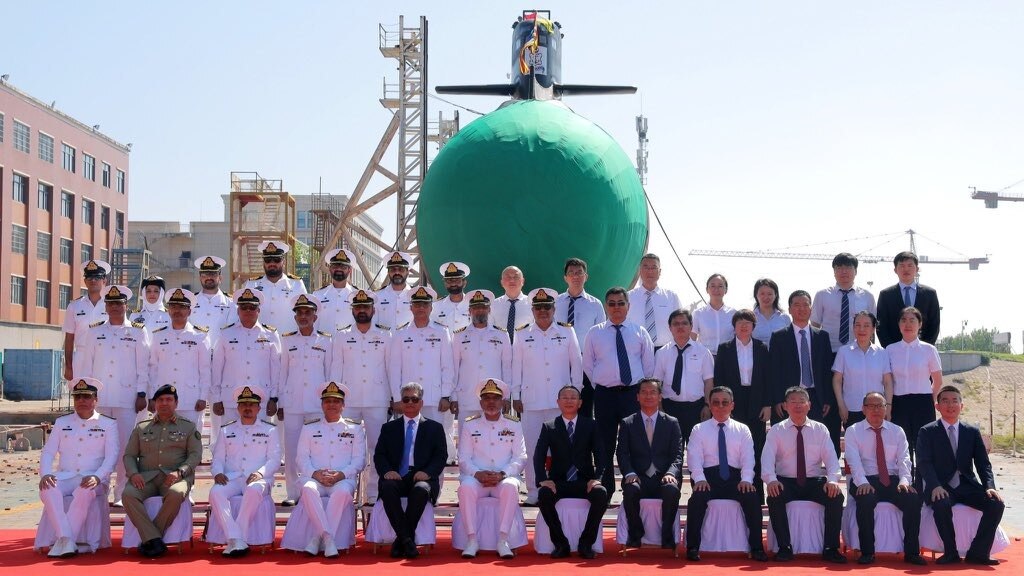

With the aid of China, Pakistan is working to extend its naval presence in the Arabian Sea by incorporating Hangor-class submarines into its naval fleet. The initial set of these underwater crafts is anticipated to become operational by 2026.
This initiative follows Pakistan’s efforts to strengthen its military alliance with China, especially after a brief conflict revealed weaknesses in its defense. The objective is to bolster Pakistan’s maritime deterrent capabilities and protect essential sea routes associated with the China-Pakistan Economic Corridor (CPEC), according to a representative from the Pakistan Navy.
In a discussion with China’s Global Times, Admiral Naveed Ashraf, the Chief of Naval Staff for the Pakistan Navy, confirmed that the Hangor-class initiative, part of a $5 billion agreement established in 2015 for eight submarines, is on track. The first submarine was launched in China in April 2024, with the subsequent vessels expected to follow in 2025.
According to Ashraf, “This project holds great importance for enhancing the submarine capabilities of the Pakistan Navy and will also foster self-sufficiency through technology transfer and skill enhancement,” he stated to the Global Times.
With the imminent arrival of the submarines, China’s support for Pakistan is now also reaching the maritime domain.
China has significantly contributed to the modernization of Pakistan’s air and land military forces as well. Data from the Stockholm International Peace Research Institute (SIPRI) indicates that 81% of Pakistan’s arms imports from 2020 to 2024 originated from China.
In the aerial sector, Beijing co-developed the JF-17 Thunder multi-role fighter jet, a key component of the Pakistan Air Force with more than 150 units currently in operation, designed for both air-to-air confrontations and precision strikes.
On the ground, Pakistan has deployed Chinese VT-4 main battle tanks, which feature advanced fire control systems and superior mobility, in armored divisions along conflict-prone borders.
The Hangor-class submarines, powered by diesel-electric engines and equipped with air-independent propulsion for prolonged underwater missions, are set to improve Pakistan’s anti-submarine warfare and surveillance capabilities in the Northern Arabian Sea. Ashraf highlighted their importance in protecting routes associated with CPEC. Complementing these submarines are the Type 054A/P frigates, which are also produced collaboratively by China and Pakistan. Four of these frigates are already functioning within the Pakistan Navy.
Expressing optimism about the future of Sino-Pakistani relations, Ashraf anticipates greater collaboration in unmanned systems, artificial intelligence, and electronic warfare.
This week, as Pakistan hosts the second Pakistan International Maritime Expo and Conference (PIMEC) in Karachi, the emphasis on blue economy projects may further solidify these strategic alliances, as reported by Global Times.
INDIAN NAVY DOMINATES THE NORTH ARABIAN SEA REGION
In light of these developments, India’s naval strength in the Indian Ocean Region (IOR) continues to remain unmatched, with a powerful fleet that surpasses Pakistan’s in terms of tonnage, firepower, and operational reach.
The Indian Navy is equipped with two aircraft carriers—INS Vikramaditya and the domestically produced INS Vikrant—alongside an expanding submarine fleet featuring six Kalvari-class submarines and nuclear-powered ballistic missile submarines such as the INS Arihant.
Its surface fleet comprises over a dozen destroyers and frigates, including Kolkata-class vessels equipped with BrahMos supersonic missiles.
This superiority was demonstrated during Operation Sindoor, when the Indian Navy maintained a high state of readiness to deter any potential escalations in the Arabian Sea.