

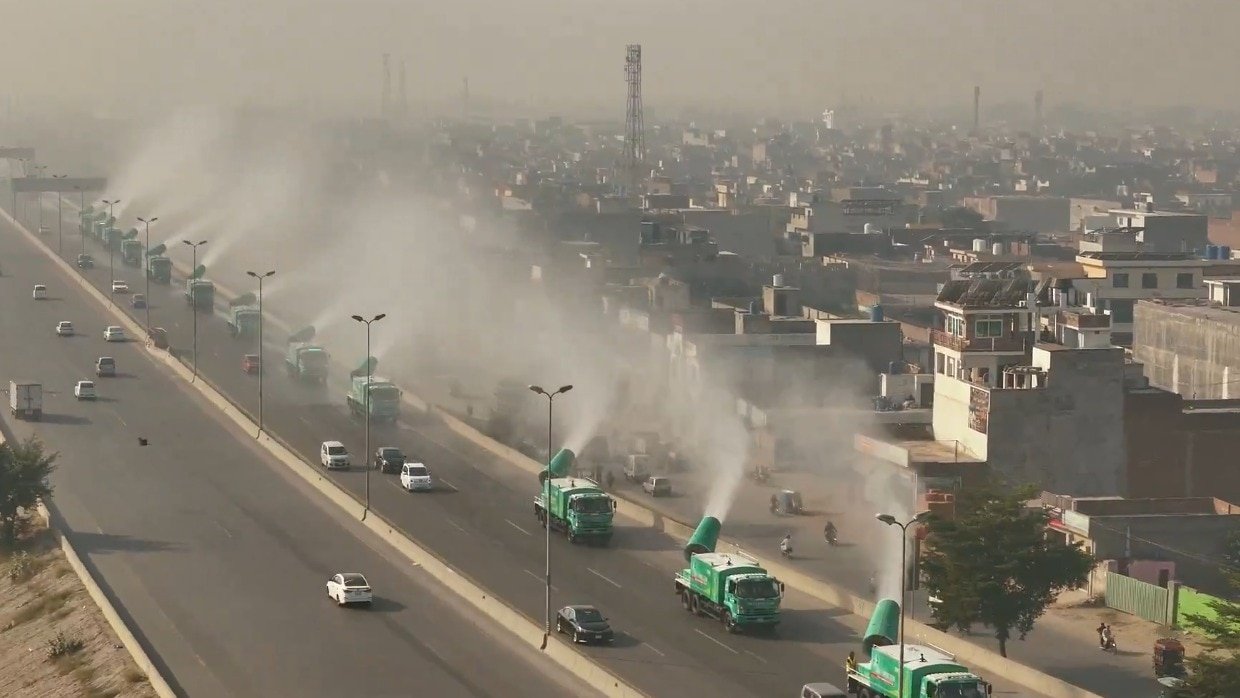

Amid the vibrant Diwali festivities that illuminated the Indian skies last weekend, a somber air quality situation unfolded in Pakistan’s Punjab province, particularly in Lahore. The deteriorating air quality prompted urgent action from the provincial government led by Maryam Nawaz. Officials in Pakistan attributed the decline to a mix of local emissions, pollutants drifting over from India, especially New Delhi and other northern cities, exacerbated by Diwali fireworks, and sluggish wind speeds.
By Tuesday morning, Lahore’s Air Quality Index (AQI) had surged to 266, ranking it as the second most polluted city globally, trailing only behind New Delhi. The Punjab Environment Protection Department pointed out that winds transporting pollutants from Indian cities significantly worsened air conditions in Punjab, Pakistan.
In response to the toxic air, the Punjab government activated emergency measures, including deploying anti-smog guns and conducting water sprinkling operations on key Lahore roads. Multiple departments are involved in these efforts, alongside the formation of smog response squads to crack down on air pollution sources. The low wind speeds, ranging from 4 to 7 km/h, facilitated the spread of airborne particulates across the border, affecting cities like Lahore, Faisalabad, Gujranwala, Sahiwal, and Multan.
Lahore, on Monday evening, was ranked as the third most polluted city globally, with an AQI reaching 182, classified as very unhealthy. Kolkata and New Delhi were ahead with AQI levels of 203 and 213, respectively. By Tuesday morning, Lahore’s AQI worsened to 266, placing it as the second most polluted city worldwide. IQAir reported PM2.5 concentrations in Lahore at 187 g/m, significantly exceeding the World Health Organization’s safe air limits.
Marriyum Aurangzeb, a minister in Maryam Nawaz’s Cabinet, emphasized the cross-border environmental challenge and urged citizens to reduce local emissions while monitoring incoming pollutants. She highlighted the impact of winds from Amritsar, Ludhiana, and Haryana on polluting Lahore’s air, projecting an AQI range of 210 to 230.
Furthermore, actions in Lahore included covering construction materials in open areas, restricting traffic on key routes, and imposing fines or seizing vehicles emitting smoke. The Lahore police crackdown led to the arrest of 83 individuals involved in activities contributing to smog, such as emissions from factories and burning tires and waste.
On the other side of the border, Delhi faced hazardous air pollution levels post-Diwali, with PM2.5 concentrations exceeding 248 g/m in most areas despite restrictions on fireworks. The aftermath of Diwali left behind a lingering haze, casting a visible shadow on both sides of the border.